AI "Cited" You.
That's Not the Same As
AI "Recommending" You
Happy Tuesday! Last week, I showed you a page Google hasn't indexed, that AI cites across seven engines.
Rereading it, I realized I left the obvious question hanging: if AI is citing us, we've won, right?
Not quite. This week I want to draw the line between two words that get used interchangeably, and the difference decides whether your AI visibility campaign makes money.
Citation vs Recommendation
In Plain English
Two words, two very different outcomes:
- Citation: AI uses your content as a source. Your URL shows up in the little chip, the side panel, or the "sources" list at the bottom of the answer.
- Recommendation: AI names your brand in the answer itself. "For that, look at Brand A, Brand B, or Brand C."
One is a footnote. The other is a shortlist:
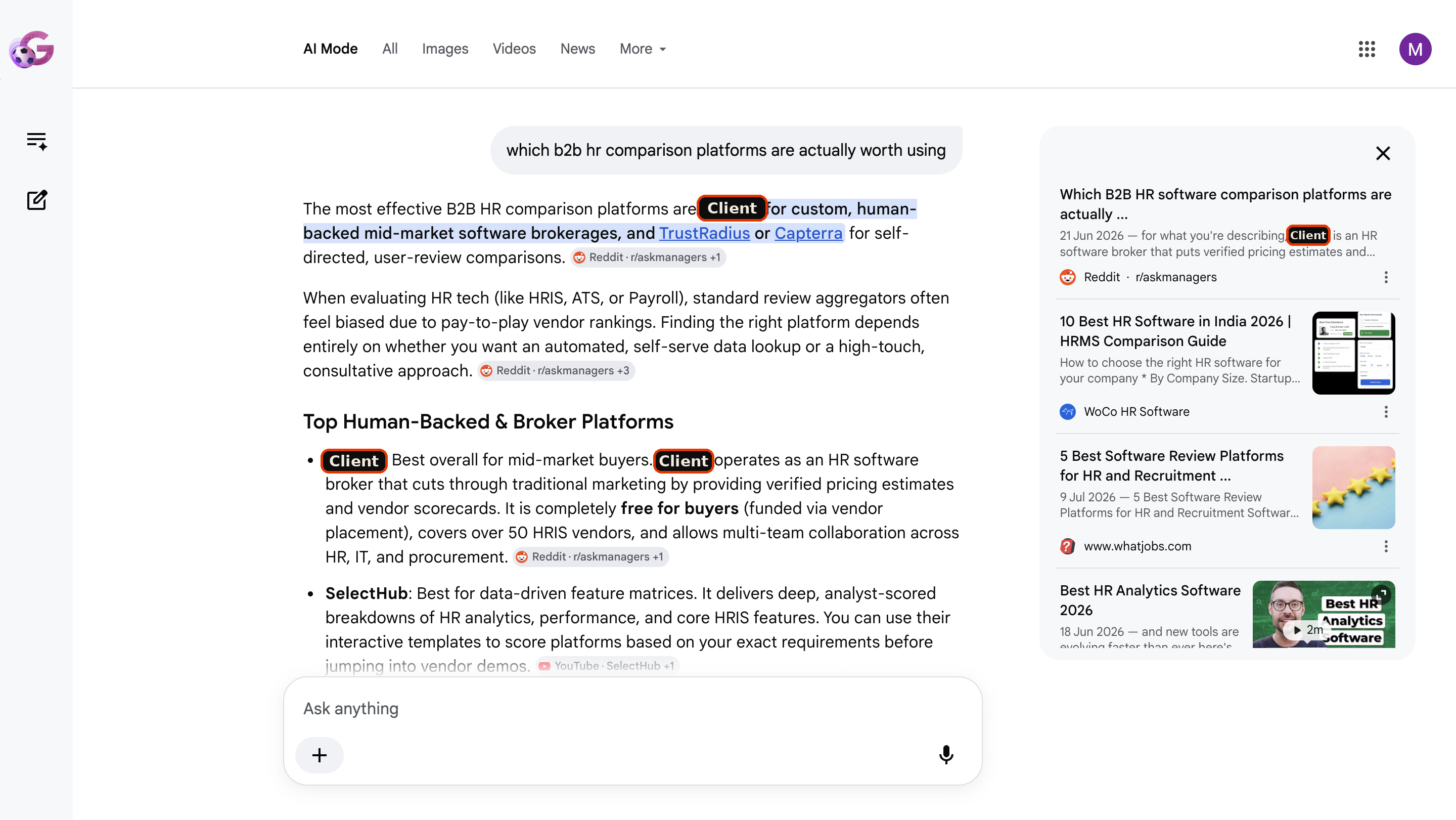
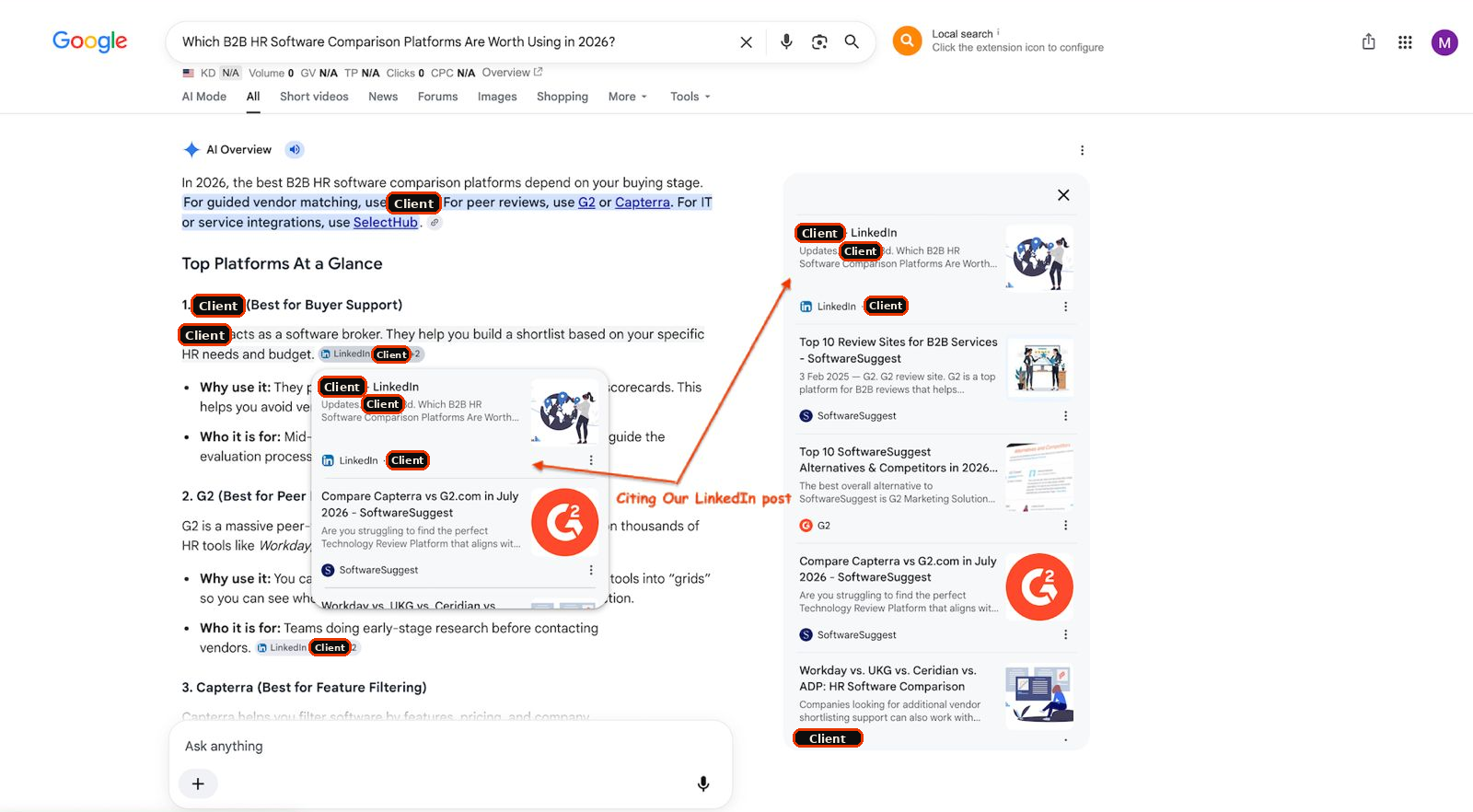
Your customers don't click the footnotes. Almost nobody, anyway.
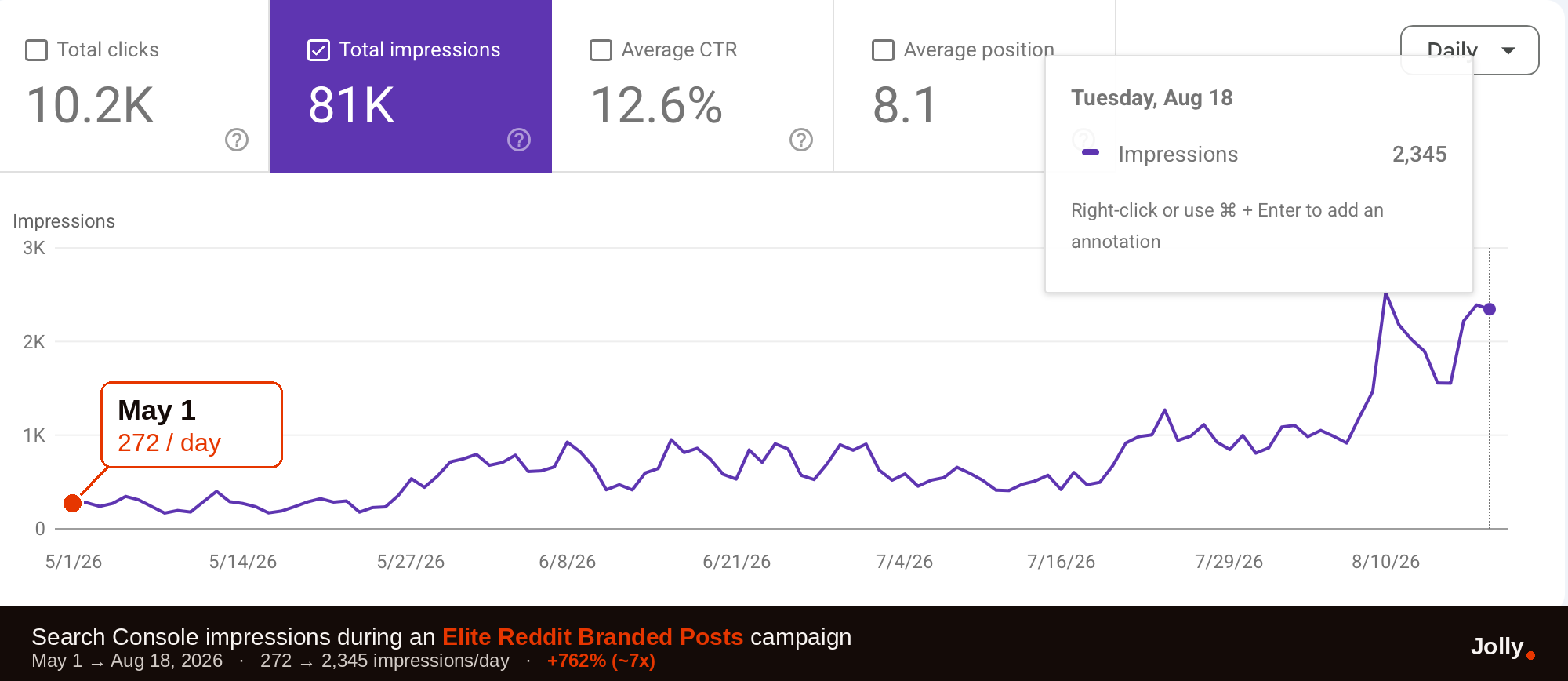
What your customers do do is read the three or four names in the answer, open a new tab, and Google those brands.
That branded-search bump is the front-end signal I walked through last week. If you missed it, it's in the archive:
Why a Citation Doesn't Automatically Become a Recommendation
Here's the part I only understood after Muskaan, who runs our production side, walked our sales team through it this week.
- By the way, do you want a walk-through? Muskaan is filming an AI Visibility FAQ episode with me next week. Send me your question, and we'll answer it in the episode!
AI engines don't recommend brands for every question. They recommend brands when the question asks for one.
A client of ours flagged that they weren't ranking for a prompt that matters to them. It was a "What is [our service]?" definition prompt. (Niche and wording masked to protect the client.)
Run that kind of prompt in Google AI Mode and you get a definition, common examples, and how it works. It's a lesson, not a shortlist.
The best that prompt can ever do for you is make you a cited source. A blog post, a YouTube video, a Reddit thread of yours gets pulled in as evidence.
The AI is not going to volunteer "and by the way, hire this firm." The user didn't ask for a firm.
Change the prompt and everything changes:
- "What is [service]?" → a lesson. Best case: you're a footnote.
- "Best [service] provider near me?" → a shortlist. Now a recommendation is even possible.
TL;DR:
- The first question isn't "How do we get recommended?"
- The first question is: "Does the prompt we're chasing trigger recommendations at all?"
The Three Rungs
Now we've clearly defined the two words, phew! Time to triage.
Every brand we work with lands on one of three rungs for a given prompt:
- Absent. AI doesn't know you exist for this question. Most brands, most prompts.
- Cited, not recommended. AI trusts you enough to borrow your data, but not enough to put your name in the answer. The client in these screenshots started exactly here: cited for dozens of prompts, recommended for almost none.
- Recommended. Your name is in the shortlist, ideally at the top. Our AI music client sits at #1 for their money prompt, one spot above Adobe.
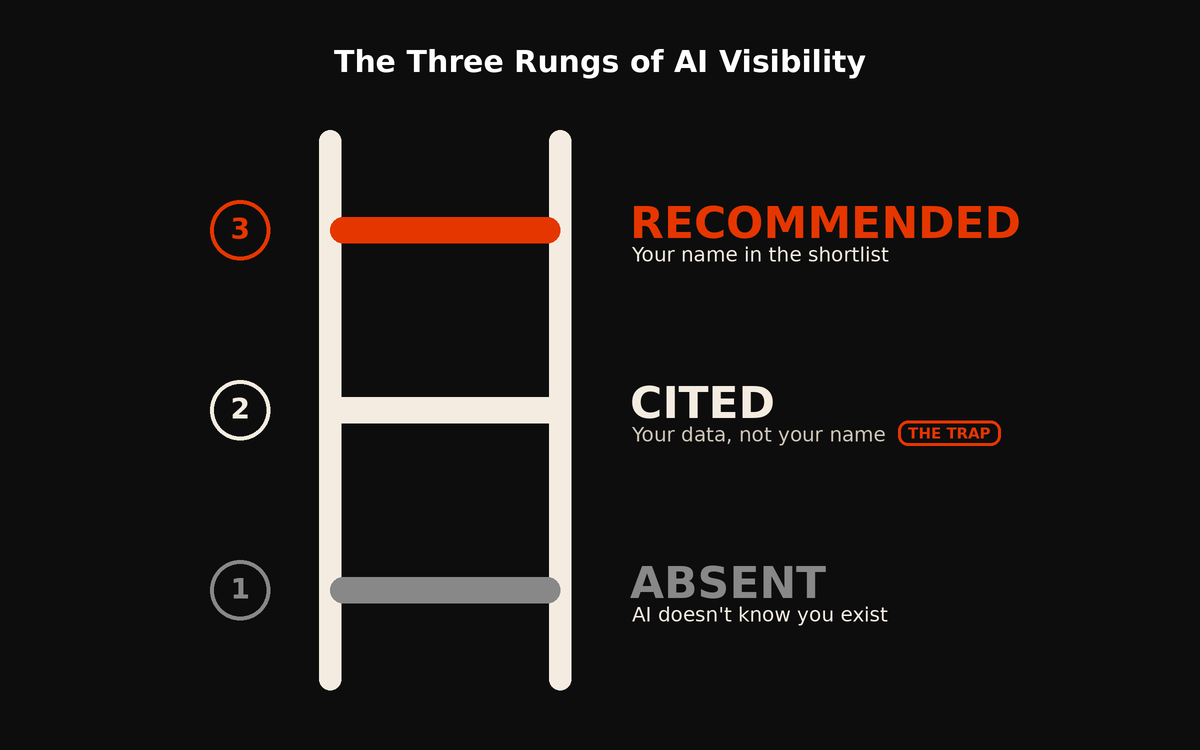
Rung 2 is the trap. It looks like progress in a report, and it is progress, but it doesn't put you in front of a buyer.
What Moves a Brand
From Cited to Recommended
Two things, based on what we've watched across engines this summer:
- The prompt has to be a buying prompt. Bottom of funnel, comparison, "best X for Y." If the client picks the prompt, they usually pick an informational one, because that's what they'd Google. We now pick the prompts, and we build them off the client's target keywords instead.
- AI has to believe you're credible enough to name. Citing is cheap for the model. Recommending is a reputational bet, so it validates first.
We've watched the crawl order: the asset that answered the question then the About page then the shipping page.
LLMs' crawler bots find the answer, ask "Who are you?," then check "Can you actually do the thing you claimed?"
If your site can't survive that check, you stall at rung 2 no matter how many places mention you. That's the whole reason our Own A Prompt campaigns pair off-site assets like YouTube, LinkedIn, Reddit, and earned media brand mentions with on-site pages that back up the same claim.
Why This Matters More Than a Click
Muskaan's line to the team stuck with me:
"AI recommendations are the most credible real estate on the internet right now."
These recommendations are earned, not bought.
- Very on-brand for us! (so forgive the excitement)
It also means not being there is expensive in a way that doesn't show up as lost clicks. If a buyer asks their category question and you're not one of the four names, they never evaluate you. You're not losing the comparison. You're not in it.
The Takeaway
Next time someone on your team says "we're showing up in ChatGPT," ask one follow-up:
- Cited or Recommended?
Then run this quick check:
- Pull your target prompt. If it starts with "what is," you can be a footnote at best.
- Find the buying version: "which," "best," "vs." That's where the shortlist lives.
- Ask it in ChatGPT and Google AI Mode. Are you absent, cited, or recommended?
And if you'd like us to run that check on your money prompts, hit reply or grab a call. Ten minutes and I'll tell you which rung you're on.
Until next week,
Greg
P.S. Getting from rung 2 to rung 3 is an off-page game: the Reddit threads, YouTube videos, and LinkedIn posts AI leans on for corroboration, backed by a site that survives the validation crawl.